Breaking the Linear Mold: Why Design-Build is a Game Changer for Ecosystem Restoration
•
September 23, 2026
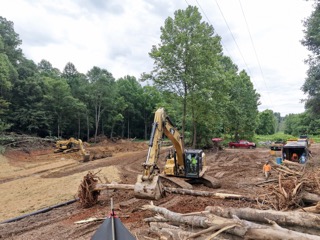


In the ecosystem restoration industry, the Design-Build (DB) model is gaining ground over the traditional Design-Bid-Build (DBB) approach. Natural systems are dynamic, unpredictable, and rarely follow a set of plans perfectly.
In traditional civil works projects, the path is often very direct: an engineer designs a road (or other piece of infrastructure), a contractor bids on the plans, and the project gets built nearly exactly as drawn. But streams, rivers, floodplains and wetlands aren't roads. They are living systems. When we try to force a Design-Bid-Build (DBB) mentality onto a stream restoration project, we often run into a pile of change orders, finger-pointing, and ultimately the project owner and ecological uplift potential are hurt.
This is why more project owners are turning to Design-Build (DB) as a contracting mechanism for ecosystem restoration projects. By integrating the designer (engineer) and the builder (contractor) into a single team from day one, the DB model aligns the incentives of all three parties (owner, designer, and builder) around a shared outcome rather than separate contracts. Risk is carried by the team best positioned to manage it, field decisions get made in hours instead of weeks, and the collective energy goes into building the best possible project instead of documenting who's responsible when working through something unexpected in the field.
In a traditional DBB setup, the project is structured like a relay race where the baton can be dropped. Three different parties: the Owner, the Designer, and the Builder, are each bound by separate contracts and, often, with incentives that do not align. The Designer and Builder frequently end up in an adversarial relationship, and the owner is left holding the bag (and the bill).
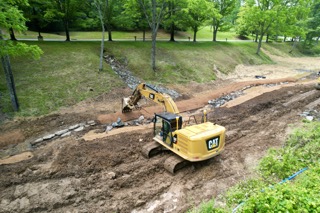
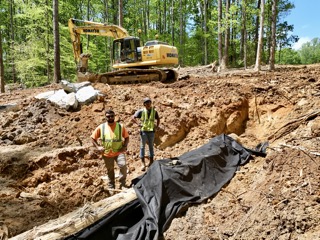
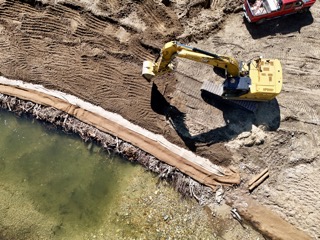
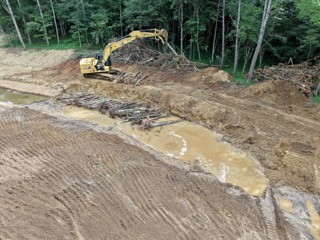
In the context of an ecosystem restoration project, this creates friction in three specific ways:
1. The Low-Bid Trap vs. Ecological Function
In DBB, the contract is almost always awarded to the "lowest responsive bidder." While this looks good on a municipal balance sheet, grant budget or in a proforma for a private company (i.e. the all-important IRR), it can be pretty rough for a trout stream, wetland bogs and hellbender habitat.
A Builder who bid razor-thin margins to win the job will almost certainly look for ways to make up that margin. They become incentivized to complete the work as fast as possible, not to spend two hours perfectly orienting a boulder or wood structure to create the micro-habitat the designer envisioned. If the plan says "place 3 habitat rocks in the glide" (because we want our hellbender friends to have good cover), the Builder will likely place 3 rocks in the easiest way possible even if a slight adjustment would have captured the intent of the design and improved the function of the structure.
2. The Finger-Pointing Phase
Because the Designer and Builder have no contractual relationship with each other, the Owner sits uncomfortably in the middle. Consider this scenario: A bankfull event occurs mid-construction and washes out a newly installed riffle.
The Builder claims the design was flawed and didn't account for the velocity and shear stress, thus requesting a change order to install more stone. The Designer claims the Builder didn't install the riffle material to the size and depth specified in the plans and denies the change order. If you have been on either side of this in the ecosystem restoration industry, you know it’s terrible and all too common. The Owner is left paying for the repair while the two professionals argue over who is at fault.
3. Creativity and Innovation is Penalized
In a DBB contract framework, once the contract is awarded there is little incentive for the Builder to suggest a better or more ecologically beneficial way to complete a task during construction.
If the Builder finds a source of native boulders and cobble on-site that would work better than the quarry stone specified in the plans, they don’t have much of an incentive to alert the Designer and Owner. The Builder is likely being paid on unit price basis for a certain amount of quarried stone to be hauled in and installed. Attempting to use the native stone would require more RFIs, changing the specs in the plans and details, potentially a formal contract amendment and more down time. In DBB, "different" is seen as "risky," which stifles the creative problem-solving that is essential when working in a natural system and striving to be a value-add for the Project Owner.
Why Design-Build Works for Stream Restoration
Ecosystem restoration projects get messy during implementation, and field conditions can be variable and uncertain. You might dig a pool only to find a buried utility line, bedrock or a soil type you didn't expect. In a Design-Build scenario, the Designer is on-site or a phone call away from the operator to troubleshoot in real time or discuss alternatives. They can adjust the grade, alignment or the structure placement without stopping work. During construction, the ability for the Designer and Builder to communicate directly and adapt in real time can be the difference between a successful project that works with the stream and one that fights it.
Some of the best stream and river restoration designers we know don't have a PE or technical training. But they have 20 years of experience operating an excavator, fitting boulders together and observing how the stream flow interacts with a new channel or structure. In Design-Build, the contractor provides constructability feedback during the design phase. They can tell the designer, "That boulder placement looks great on the plans, but I can't get a machine in there without destroying three specimen oaks and building an access ramp down the side of the valley." Good things to know before you get into construction. This collaboration prevents the development of designs that are impractical to build in the field. It delivers field-driven ideas that make the design better.
Because the design and construction preparation phases overlap and there is only one procurement phase at the beginning of the project, the overall project delivery timeline is usually shorter. Procurement happens once rather than twice. For restoration projects, a shorter delivery window makes it far easier to hit narrow in-stream work windows driven by moratoria, and to meet expenditure deadlines on grant-funded projects. Furthermore, the Design-Builder takes on the risk of the project's performance, which often leads to more creative, cost-effective solutions to meet the project's goals and Owner’s expectations.
The Challenges
While DB is an efficient and effective method for project delivery, it requires a shift in mindset. The Owner must trust the Design-Builder to deliver the project as scoped. That trust shouldn't be blind. It should be earned through a qualifications-based selection and reinforced with the right contract structure. Writing a Request for Proposals (RFP) for a Design-Build project is also harder than a standard bid. You have to define performance goals (e.g., "stabilize 500 feet of bank using natural materials and improve aquatic habitat") rather than quantities (e.g., "place 200 tons of Class 1 riprap"). Getting the RFP right takes more up-front effort from the Owner, which will unlock the flexibility, creativity and value-add that the DB model is known for.
Finally, not every Owner can use DB for every project. Public procurement rules vary by state and agency, and some funding sources carry their own delivery-method requirements so it's worth confirming your ability to use DB early in project planning.
Tips for Success
If you're considering a Design-Build approach for your next ecosystem restoration project, keep these three things in mind.
Pick the team, not just the firms. Since the Designer and Builder must work as one unit, their relationship is the project's most important asset. Look for teams with a proven track record of working together. Ask about specific projects they've delivered as a team, and how they handled the moments when things got sideways during the design phase or in the field.
Establish known benchmarks. Because the design will evolve, you need a fixed point to navigate by. Whether it's nutrient reduction credits, fish passage, feet of channel restored or infrastructure protection, make sure the primary goal is locked in from the start and measure every field adjustment against it.
Bring the regulators along. As we discussed in our previous post on permitting, regulators can be wary of the dynamic nature of Design-Build. Bring them into the discussions early so they understand that field adjustments are being made to improve the ecological outcome, not to cut corners. A regulator who has walked the site with your team is far more comfortable with adaptive management than one reading about it in a permit modification request.
Ready to Break the Mold?
Natural systems don't always follow a set of engineering plans, and the best restoration projects come from teams built to adapt alongside them. North State Environmental, Jennings Environmental and River Mechanics have delivered stream and river restoration projects as an integrated design-build team, and we've seen firsthand how the model adds value to the Owner and increases ecological functional uplift. If you're an owner weighing delivery methods for an upcoming restoration project, reach out. We'd be glad to talk through whether Design-Build is the right fit.

JP founded River Mechanics in 2020 after several years conducting applied research and teaching at NC State's Bio&Ag Engineering Department. He has led more than 200,000 linear feet of stream and river restoration across the Southeast and is licensed in NC, SC, GA, TN, and VA.

Greg Jennings, PhD, PE, is a leader in designing and implementing sustainable ecosystem restoration solutions to achieve ecological and regulatory objectives for environmental enhancement. At Jennings Environmental, Greg leads a 9-person team of engineering and science experts that excels at restoration planning, engineering design, hydraulic modeling, permitting, construction administration, monitoring, and education for a wide range of ecosystem restoration projects. Greg’s team has completed more than 60 planning studies and 330 successful ecosystem restoration projects in the Carolinas and surrounding states.

Darrell has 30 years of business experience and project management in stream restoration, wetland mitigation, dam removal, bridges, at-grade stream crossings, culvert and pipe installations, greenways, trails, stormwater BMPs, energy dissipaters, storm drain systems, bio-retention, erosion control, bioengineering, and reforestation. He has overseen the installation of more than 1.4 million linear feet of stream restoration and 1,200 acres of wetland restoration.
.png)
Brandon has worked with North State for 21 years specializing in stream and wetland construction as an operator, foreman, construction manager and currently holds the Chief Operating Officer. He has overseen the completion of more than 50 projects involving over 175,000 feet of stream restoration. Brandon combines his many years of operator and foreman experience with his understanding of stream functions and design to provide detailed construction sequencing and constructability reviews.